How often should a private storm drain be cleaned?
There is no single schedule for every property. Surrounding trees, leaf and sediment exposure, property use, drainage performance, and past restrictions all affect how often attention may be needed. Inspect accessible grates after visible debris collects and when drainage slows or water begins spreading beyond its normal path. Cleaning should respond to actual conditions rather than an invented universal interval.
Who cleans storm drains?
Responsibility depends on ownership. A drain-service provider may clean a suitable accessible storm drain or outdoor drainage line located on private property. Drains in public streets and municipal stormwater systems should be reported to the responsible public agency rather than opened or serviced without authority. Confirm the drain location and ownership before arranging private work.
How is a storm drain cleaned?
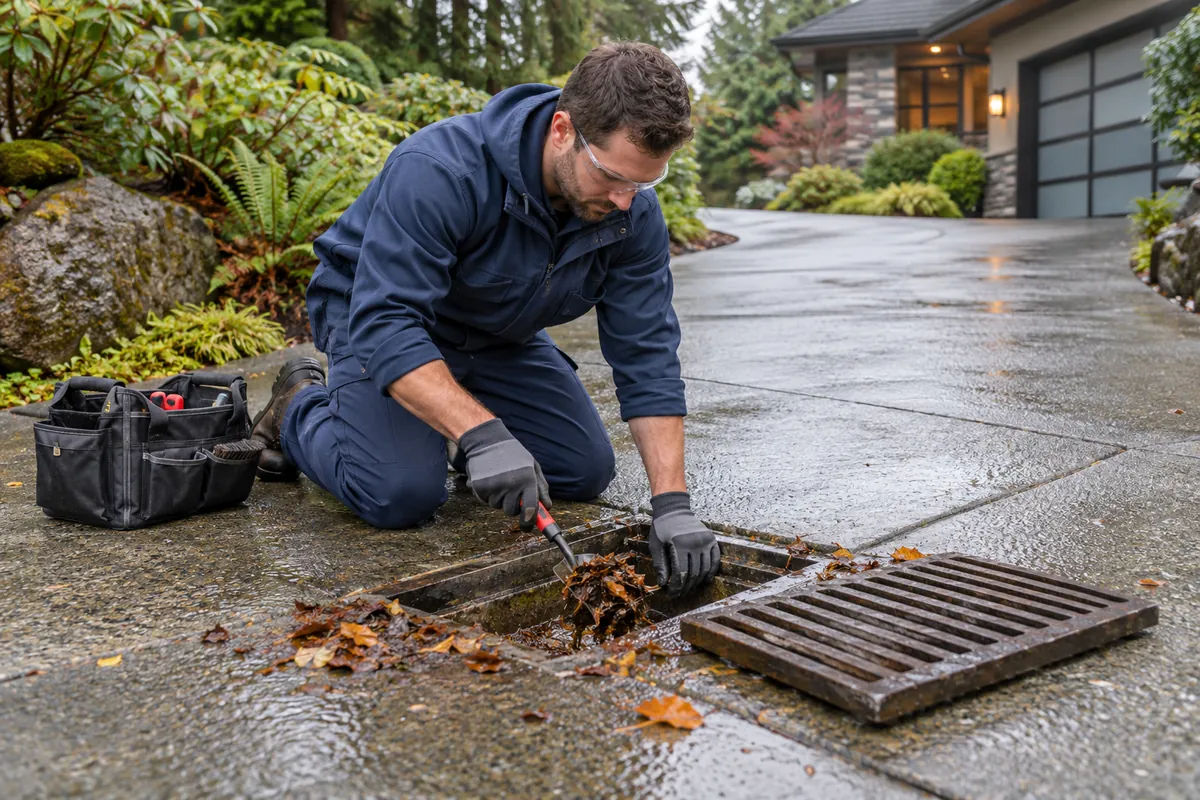
The process begins by confirming that the drain is on private property and reviewing where water collects. Accessible leaves and loose debris may be removed from the inlet. If the connected line appears restricted, a suitable cleaning method may be considered based on access and pipe condition. Drainage can then be checked with controlled water when site conditions allow.
What affects storm drain cleaning cost?
Cost depends on the drain type, property access, standing water, visible debris, connected-line configuration, restriction location, and the method needed. Surface debris removal and work on a restricted connected line can involve different scopes. Pumping, excavation, repair, or drainage redesign should not be assumed to be included. Describe the site and symptoms when calling instead of relying on a fixed price.
Can leaves and sediment clog an outdoor drain?
Yes. Leaves, needles, soil, sediment, and litter can cover an inlet or collect in an accessible drain. Removing visible material may improve intake, but surface debris does not prove the connected line is clear or blocked. If water continues to pool, the line, grade, drainage capacity, or pipe condition may require further assessment.
Can storm drain cleaning stop all water pooling?
No. Cleaning may improve drainage when accessible debris or a line restriction is the problem. Water can also collect because of grading, inadequate system capacity, saturated ground, damaged or disconnected pipe, or another site condition. Cleaning has a defined purpose and should not be presented as a guarantee against pooling, overflow, or property flooding.
Is hydro jetting always used for storm drain cleaning?
No. Hydro jetting is one possible method for certain connected lines that have suitable access and pipe condition. Surface debris may require a different approach, and some systems may not support high-pressure cleaning. The line size, material affecting flow, condition, access, and intended outcome should guide the method rather than using jetting automatically.
Does Bellevue Drain Cleaning Co. clean residential and commercial storm drains?
Yes. Bellevue Drain Cleaning Co. provides storm drain cleaning for suitable accessible private-property systems serving residential and commercial properties in Bellevue. Tell us the property type, drain location, whether the drain is privately owned, what happens during rainfall, which nearby drains react, and what work has already been attempted so the service scope can be discussed.